Showing posts with label scratch. Show all posts

Friday, April 30, 2010

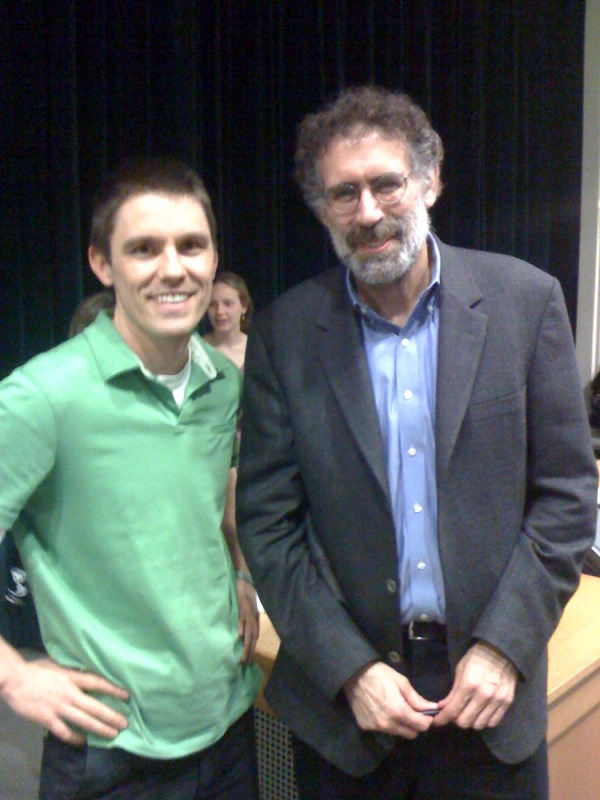
Mitch Resnick Talk at Stanford

One of the best things about working in the field of school technology and living in the Silicon Valley is the access to the incredible community based learning opportunities. I've seen Tina Seelig, Gever Tulley, BJ Fogg, Sal Khan, Chris Anderson, John Seely Brown, Daniel Pink, Carol Dweck, and Neeru Khosla within the past 9 months alone...and all within a 10 mile radius of my home here in Menlo Park, California! As of today I can add Mitch Resnick of MIT Media Lab and Scratch fame to the list.

Today I stopped over to Stanford to see Mitch give an hour long talk with Q/A on the development of the Scratch platform and eco-system. Resnick and his team of colleagues in the Media Lab have a simple philosophy behind the scratch multi-media programming and design environment, a platform that is targeted toward youth in the age range of 8-15 - they want to build a platform that empowers this age group to design and CREATE in the midst of a social, collaborative online community. He told examples of inspiring youth Scratch developers, like MyRedNeptune, who creates sprites for emerging multi-media developers to use in their scratch applications. He talked about a community member who creates anime stories and went so far as to crowd-source the art work for some of the characters in one of her.

I was intrigued to hear Resnick finish his talk with ideas on future directions for the platform. His team is investigating how they'll move the Scratch to the cloud to foster even more collaboration...imagine being able to design and share Scratch projects directly through the browser. The future looks bright for this powerful multi-media authoring platform.

A few other highlights and points of interest from today's talk:
  • Mitch and his Media Lab team give scratch workshops for students. One of the ways they evaluate their workshops is by the "diversity of student projects" that they see youth creating in the session. I LOVE this evaluation criteria and hope to apply it to upcoming projects that I work on with students and teachers. 
  • "Scratch was designed to make tinkering accessible, projects more meaningful and personal, and the entire process more social. It also encourages students to think creatively, reason systematically, and to work collaboratively." Great food for thought when building powerful learning design.
  • Scratch is all about giving youth the opportunity to create their own media instead of simply being consumers of media.
Interested in trying out Scratch in your classroom? Check out the online Scratch educators community and Patrick Woessner's Scratch middle school math mini-unit.

Mark your calendars for the following opportunities to learn more about scratch:

May 22nd, 2010: International "Scratch Day"

August 11-14: Scratch Conference

A special shout-out goes to colleague extraordinaire, Heidi Chang, for keying me into this event via an email earlier this week. I'd be kicking myself if I didn't attend this great learning opportunity-thanks, Heidi!

Monday, November 30, 2009

Download Scratch!!!!

Boston Scratch MeetupImage by andresmh via Flickr
This is an email that I sent to a parent from my school here in the Bay Area. She is an educator at a nearby school and was looking for ideas on how to engage a particularly gifted 5th grade student. I immediately thought of Scratch and mentioned that I would follow up our hallway conversation with a few links and resources. So here is that email re-published in this space:

------------------------------------------------

Scratch is a programming (eg-computer science) platform developed by the good folks at MIT. They make it FREELY available for anyone to download, install and use. The thing that makes Scratch powerful is the online community. Students may submit projects to the community for others to comment on and improve upon. Alternately, students may download existing projects and review the source code and remix the source code. It is social constructivist learning at its best!

Here is the information on Scratch:

-Website Address: http://scratch.mit.edu
-Download from http://scratch.mit.edu/download


A few samples from my students in the past (this was an ungraded class...the students loved this stuff and engaged just for the fun of it):
Music Animation: http://scratch.mit.edu/projects/scratchbegginer911/133476 (I love this project...so much effort went into it)
Mario Experiment: http://scratch.mit.edu/projects/scratchbegginer911/122309 (he didn't get too far on this, but he put tons of work into it)
EtchaSketcha: http://scratch.mit.edu/projects/badgerfootball49/159376
Pong: http://scratch.mit.edu/projects/badgerfootball49/109197
Plans and Tanks: http://scratch.mit.edu/projects/badgerfootball49/138625
My Scratch Profile Site: http://scratch.mit.edu/users/mjmontagne

Guides on scratch: http://info.scratch.mit.edu/About_Scratch (scroll down and you'll see the guides...these might be useful print outs to get him started)

Support Materials, like videos, printable help cards, etc: http://info.scratch.mit.edu/Support (my strategy was to show the students videos and to set them off as soon as possible...they knew WAY more than I by the end of this class, which was fantastic).
Reblog this post [with Zemanta]

Friday, April 04, 2008

Student Scratch Project

A student that I work with in my 7th grade programming class created the following Scratch project. He is really into music and I think he enjoyed the process of putting this together. It is important to note that he did this entirely on his own and outside of our class (that is the great thing about the Scratch program-it is a free download/install and students can put it on their own personal computers quite easily).

As a side note, I'm interested in working with other teachers and schools to try to group students together to collaborate on Scratch projects/challenges with one another. I think this would be an authentic way for students to engage in collaborating across great distances on computer science coding. Let me know if you might be interested in working on such an endeavor.

Click the image below to see view and listen to the project!


Scratch Project