Sunday, August 23, 2009

Castilleja School YouTube Channel

This is just a reminder that our school has its own YouTube Channel that it will using to share videos from our school community. We foresee sharing talks by special guests, student projects, student speeches, etc. I am one of the designated video uploaders at Castilleja and I'm hopeful that we'll be able to post 1 video per week throughout the year. I recently posted Marissa Mayer's June 2009 Commencement address and the two parts to this talk are embedded below. Subscribe to our Channel if you'd like to notified when we post new videos.

Marissa Mayer Castilleja Commencement Address Part I (June 2009):


Marissa Mayer Castilleja Commencement Address Part II (June 2009):

Reblog this post [with Zemanta]

Thursday, August 20, 2009

Changing My 'Mindset'

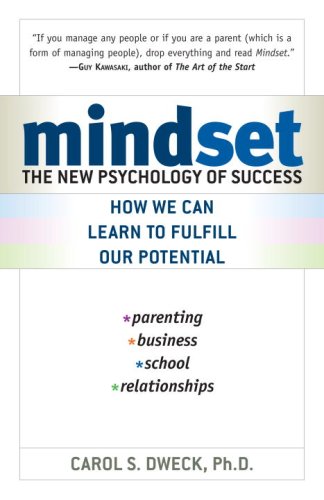
The summer reading book for our faculty and staff at Castilleja is Carol Dweck's, Mindset. I've found it a fascinating read and already am finding that it is positively affecting my own mindset about long held beliefs I've had about my ability to learn certain tasks. The essence of Ms. Dweck's book is that humans have two different types of mindsets that they slip into when learning. The first mindset is one where we believe that the ability to learn something is hardwired into our DNA. I've had the fixed mindset about learning music for years - I believe that you either have an innate ability to learn music or you don't. People who have the second mindset, or the growth mindset, have a totally different approach. They believe that new skills can be cultivated and developed through hard work and effort.

In the book she cites many examples of individuals who have taken on either a fixed mindset or a growth mindset. She tells Michael Jordan's story and how people with the fixed mindset tend to attribute his success to natural ability and great physical gifts. They forget the fact that he was cut from his high school basketball team in his senior year and that he was a notorious gym rat well before he established himself as one of the greatest NBA players ever. Michael Jordan is the classic growth minded athlete. Clearly he not only enjoyed great challenges but he thrived under these pressure situations. The video below demonstrates Jordan's perspective in failure and success:


Mindset has already had an impact on my attitude about learning new tasks. I was recently in Ludington, Michigan visiting with my family and friends. My brother-in-law, Bill, is an incredible card player. All of his children are excellent card players as well. For years they've asked me to play cards, but I would always say something like, "I'm terrible at cards," and then I'd sit on the sidelines. Bill comes from a family of card players and I've always considered his card playing ability to be hard coded into his DNA. Since becoming more aware of the various mindsets, I now am able to see that Bill's card playing skills have nothing to do with innate ability. Bill has spent hundreds, if not thousands, of hours playing cards with his family and friends over the years. He can anticipate someone holding a jack in their hand while playing euchre not because of some magical ability, but because he has tons of experience playing the game. He is poised and calm during cards not because he is a "cool-cat," but because he has a great deal of experience practicing. On my last day in Michigan, my sister asked me if I'd like to learn and play euchre with Bill and their daughter, Tenley. I put myself into a growth mindset and said, "Sure." I concentrated and applied myself a bit and while I still struggled to learn all the nuances of the game, I did learn some basic rules and now feel as though I can at least play and enjoy a game of euchre. If I didn't have the growth mindset, I'm guessing I would've turned down my sister's offer to play and learn the basics of a new card game (more importantly, I would've missed out on a fun experience with my family!)

In upcoming posts, I'll reflect on how I'm thinking about applying Mindset to my work with students on the Gator Radio Experience and students in my 10th grade advisory section.


Reblog this post [with Zemanta]

Thursday, July 30, 2009

Digital Citizenship Panel Podcast

A special thank you to Patrick Woessner for inviting me to participate in an awesome virtual panel session with the faculty at his school today. The topic of our conversation was, "Digital Citizenship," but it certainaly meandered to include a wide range of related topics. It was fun to contribute on the virtual panel with the likes of Keven Jarrett, Damien Bariexa and Chris Betcha. The recorded audio is posted below and is also available via the Digital Down Low podcast on iTunes.

Sunday, July 19, 2009

Let's Build an ePortfolio Culture!

I recently stumbled upon this ePortfolio concept map. It is an excellent illustration of what a student-centered ePortfolio space could look like. If you ask 10 people to define a learning portfolio, chances are that you'll get 10 different answers. But we can all probably agree on the language surrounding the circle in the middle of this map. ePortfolio methodology promotes reflective learning, enhances an understanding of our own learning (meta-cognition), documents learning and creates a permanent learning record.

I'm convinced that once we move toward an ePortfolio culture in our schools that the role of grades and standardized texts will be minimized and authentic student work will be valued greatly.

What are we waiting for? Let's build an ePortfolio culture in our schools now!


*Image from Cal State University's ePortfolio Portal
*Direct URL to image

Thursday, July 16, 2009

"Facebook Top 20 Learning Applications"

Short video here on the many educational applications that can be installed and utilized within the Facebook platform. A shout out to Derek Baird for posting this in his Twitterstream.

Wednesday, July 15, 2009

Making Friends Online

I'm often times asked by folks when I tell them about our student Internet Radio show, The Gator Radio Experience, "How did you find those people from [insert location here] to talk live with your students." Many people who ask this question of me probably know how to find a doctor in their community, a mechanic to repair their car, or a good babysitter to look after their children. They all have networks in their local communities that they can reference when they are in need of such resources. Finding people to collaborate with online is really no different than finding people to work with in our respective communities. However, just like it takes time to build up a support network in our local communities, the same can be said for working in the virtual world. It takes time to build up a network of trustworthy individuals who are willing and able to collaborate with us on various projects.

When my wife and I relocated to the San Francisco Bay Area a year ago, we only knew a few people. However, these few people showed us around the area and introduced us to many people that they knew. A year after our move we're still not fully established and we don't know the area that well, but we definitely have a little larger network than when we first moved here. We've gone hiking, to baseball games, dinners, etc with both new and old friends. This network has been incredibly kind and supportive to us throughout our transition. I'm sure this network will continue to expand as we get to know more people in the different aspects of our lives here in the Bay Area.

The same exact scenario plays out in online relationships and communities. It might even take more time, quite honestly, to build up rapport and trusting relationships that can be leveraged for a variety of different activities from professional development experiences to classroom projects. Just like moving to a new community, you have to be patient when you first enter an online community. Look for a few helpful people to get you started and they'll introduce you to many of their trusted connections. Be sure to share useful information as this helps you establish credibility and rapport in the online community. Build up a profile that includes your photo, your interests, your professional background, and links to any online spaces like a blog or wiki that you work in. Chances are that if you are an honest, thoughtful and caring contributor to the online community, that community will return the favor by supporting you in all sorts of powerful ways. And if you remain patient during the process of becoming acquainted with your online community, I think you'll find this to be an invaluable form of professional development and continuous learning.

*Photo-my wife, Erin, and I pictured in front of the Golden Gate Bridge early on in our transition to the Bay Area.

The Tinkering School

This is one of my new favorite TED Talks from Gever Tulley about his Tinkering School. What if we made more learning objects available within our school communities and simply permitted members of the learning community to tinker?? This is only 4 minutes long...well worth your time, I promise.

Friday, July 10, 2009

You gotta see this...

This video has been passed around the Twitters in a viral manner this morning...if you haven't seen this video, take the 3+ minutes to do so now. This might be the most creative YouTube I've ever seen. What a beautiful piece of art!

Sunday, July 05, 2009

What does your email signature look like??

With the movement to a new email system, I took the opportunity to create a fresh email signature. I took a screenshot of my signature and included it in this post. In the spirit of openness and transparency, I decided to include the major online workspaces that I use on a regular basis in my email signature. I hope that in some small way this models some possibilities for the many parents, teachers, students and administrators that I work with in my position as the instructional technology coordinator at my school.

How about you, what does your email signature look like??


Friday, July 03, 2009

My Summer Reading List

Below are a few books that I've either recently finished or plan to read at some point this summer. I should say that I've read all of these books so far using my iPhone and the kindle application. While I have many complaints about the proprietary nature of the kindle format, I must say that I find the iPhone to be an incredibly efficient e-reader. I believe I'm able to read at a much, much faster rate on my iPhone in comparison to a traditional book. I attribute this to being able to personalize the font size to the one that best suits my needs I do wish that Copy>Paste from the kindle worked...it would make it so much easier to reference excerpts from the text in blog posts.


Outliers - Malcolm Gladwell
I finished this book a few days ago and if I can get things together, I will post a review soon.


Doing School - How We Are Creating a Generation of Stressed Out, Materialistic, and Miseducated Students - Denise Pope
Probably the book that I've enjoyed the most thus far. Again, more thoughts as time allows.


The Google Story - Mark Maiseed
I started this book a few months ago and set it aside for a bit. I finally had the opportunity to finish it up last week. A good read, but I haven't enjoyed it nearly as much as the other Google-related book that I just started reading, What Would Google Do?


What Would Google Do? - Jeff Jarvis
This book is absolutely fascinating. I'm currently about at the half-way point in this book and feel as though it is a must read for school leadership. I've bookmarked many passages along the way and hope to reflect further on Jarvis' excellent book in a future post.


Mindset: The New Psychology of Success -Carol Dweck
This is our school's faculty summer reading book and I'm eager to begin reading this as it has been on my list for quite some time now.